Rflect is assessment infrastructure for human skills. It turns structured reflection into a defensible record of how a student's thinking actually developed over time, not what they performed in a single exam.

Structured reflection with prompts that matter, turning experience into skills.
AI-assisted activity design in minutes, in an interface lecturers enjoy using.
Real-time insight into how thinking develops, and longitudinal evidence that can replace the broken essay.
Intention
Rflect is built on learning science, psychology, and decades of educational research. The result: a platform that develops the competences universities promise and employers expect, such as collaboration, resilience and critical thinking, directly for academic credit.
Integration
Rflect fits into any existing module or runs as a standalone program-level course spanning multiple semesters. Either way, it gives universities a consistent, structured approach to student inner development across their entire curriculum.
Every week, students complete guided learning activities: reflections, self-assessments, and peer coaching, that connect theory to experience. Lecturers curate the journey. Students set personal learning goals, track their own development, and build self-awareness and adaptability.

Every course in Rflect is built around clear, revisitable learning goals aligned with your learning outcomes. Shared frameworks and a common language make inner development consistent across programs, while remaining flexible enough to fit any pedagogical approach.

Rflect turns qualitative reflection into structured, actionable insights. Students track their own development over time. Lecturers and program directors see engagement, progress, and early warning signs without having to go looking for them.

Students define personal learning goals, receive feedback, and revisit their goals as they grow. Learning becomes personal, purposeful, and tracked over time.
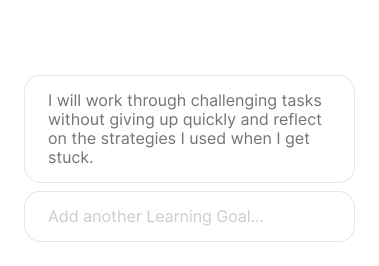
Structured reflection questions help students make sense of their experiences, and articulate their learning. Not just what happened, but what it means to them.

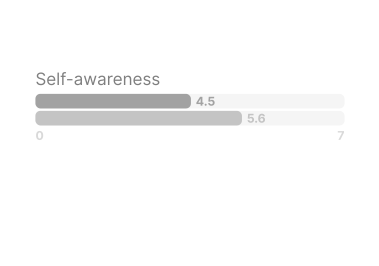
Students see where their competences are strong and where they have room to grow. Honest, structured, and built to encourage development rather than judge performance.
Students apply course insights together through structured exchanges. They practice giving feedback, learn from each other's perspectives, and build valuable collaboration skills.
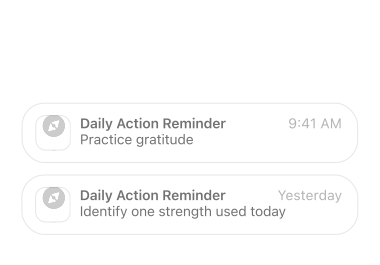
Students turn reflections into concrete next steps. Learning becomes tangible and reinforced through intentional practice.
For students who want to explore further, an optional AI extension offers additional prompts and perspectives to help them dive deeper into their reflections and learning goals.
Rflect develops students' human skills — the personal, social and cognitive skills that matter in work and life but are hard to teach through traditional methods. It combines five elements in one platform:
The effect: students move from passive recipients of knowledge to active drivers of their own learning.
Three dimensions:
What you cannot see: individual self-assessment results (only aggregated class results) and private reflections — by design, so students answer honestly. You use Rflect to create the conditions for growth; the development happens in the student.
For more, you can view our privacy policy on our Imprint page.
Yes. Rflect is used as a credit-bearing component at several universities, with a typical allocation of 1–3 ECTS per semester.
Good to know: Program learning outcomes can be entered in Rflect and mapped to human skills, and pre/mid/post assessments (self, peer, and third-party) generate structured, longitudinal documentation of competence development — usable as direct measures for accreditation processes such as AACSB Assurance of Learning.
If you're considering integrating Rflect as a marked course component, we're happy to share how other institutions have approached it: info@rflect.ch.
Rflect supports LTI 1.3 integrations with platforms such as Moodle, Canvas and Blackboard. Working with another platform? Get in touch so we can discuss a bespoke LTI integration.
Yes, Rflect does include AI-assisted features. For example:
Our users' data privacy is important to us and we are doing our best to ensure a safe and pleasant experience for all. User data never leaves the EU, and Rflect only uses AI models hosted by AWS in the EU. No data is stored by the model hosting provider and Rflect never uses student data to train AI models. Students can opt out of AI features in the Settings page.
Our dedicated team of developers and learning curators are here to help. Send your question or report a bug (where possible with a screenshot) to: help@support.rflect.ch.
Rflect is available as a native app for iPhone, iPad, and Android, downloadable from the App Store and Google Play Store. Students can also access Rflect from any browser.
With the app installed, students can enable push notifications so they're alerted directly on their phone whenever a new reflection opens — more reliable than email for most students. The app is for the student side; lecturers manage their programs via the browser.
Currently the Rflect UI supports German, English and Spanish. User-generated content, e.g. guided reflections, can be in any language.
Got questions? We'd love to hear them: info@rflect.ch