
Does Rflect With and Without AI Improve Students’ Inner Development? Results From Our Innosuisse Study
An Innosuisse project with the Institute for Work, Organization, and Transformation at the University of St. Gallen, Fall Semester 2025
Key findings:
- Students’ scores improved significantly across the semester in all five Inner Development Goals (IDG) dimensions: Acting, Being, Collaborating, Thinking, and Relating.
- Students also improved significantly on 17 of the 23 individual skills measured within those dimensions, including Communication Skills, Self-Awareness, Critical Thinking, Trust, and Perseverance.
- This growth held for students using both the AI-supported and non-AI versions of Rflect.
- A small number of specific personal constructs — including Courage and Respect — showed a stronger relationship with time spent reflecting among students in the No AI group than among AI-group students, a pattern worth investigating further in future studies.
Executive summary
During the fall semester of 2025, Rflect partnered with the Institute for Work, Organization, and Transformation at the University of St. Gallen on an Innosuisse-funded, multi-institution study examining the following research question: how does Rflect with and without AI features affect the inner development of students, as defined by the Inner Development Goals (IDG) guide?
This focused analysis was conducted by Anna Jasinenko and Michael Ohlinger at the University of St. Gallen, using validated assessment scales for the five IDG dimensions and 23 underlying skills. The headline result is encouraging: students who reflected regularly using Rflect — whether or not they had access to AI-powered feedback — signalled improvement across all five IDG dimensions and the large majority of individual skills over the course of the semester.
When we look specifically at whether AI feedback made a measurable difference on top of reflection alone, the picture is more mixed: at the level of the five overall IDG dimensions, there was no statistically significant difference between the AI and No AI groups. A handful of narrower, specific constructs did show differences — in a few cases favouring the No AI group — which we report transparently below and see as worth exploring further.
An important note on interpretation: due to an internal error, the study’s control group (which received no reflection tool at all) unfortunately did not complete a post-semester assessment, so this analysis is not able to compare reflection with Rflect against a true no-intervention baseline. The findings below describe change within the group of students who used Rflect (with or without AI), not a comparison against not reflecting at all.
About the study
The study ran across 8 institutions in Switzerland and Germany, 21 lecturers, and 28 courses, comparing a control group (no reflection tool), a group using Rflect without AI features, and a group using Rflect with AI feedback. Courses were allocated to one of two conditions:
- Experimental group 1 (No AI in Rflect): students used the Rflect app to reflect throughout the semester, without AI-powered feedback.
- Experimental group 2 (Full AI in Rflect): students used Rflect with AI feedback and an AI-powered reflection dashboard available to them.
All experimental-group students completed a pre-survey, reflected regularly in Rflect over the semester, and completed a post-survey, with each dimension and skill rated on a 1–7 self-assessment scale. As is common in semester-long, multi-institution studies, the sample size varies across analyses depending on how many students completed a given scale at both time points — individual skill and construct-level analyses in this report range from roughly N = 29 (Relating) to N = 566 (Self-Awareness).
This particular analysis focuses on the Inner Development Goals guide: five broad dimensions (Acting, Being, Collaborating, Thinking, Relating), each made up of several underlying skills (23 in total, such as Self-Awareness, Critical Thinking, Communication Skills, and Trust), which are in turn built from more specific psychological constructs (such as Honesty-Humility or Growth Mindset).
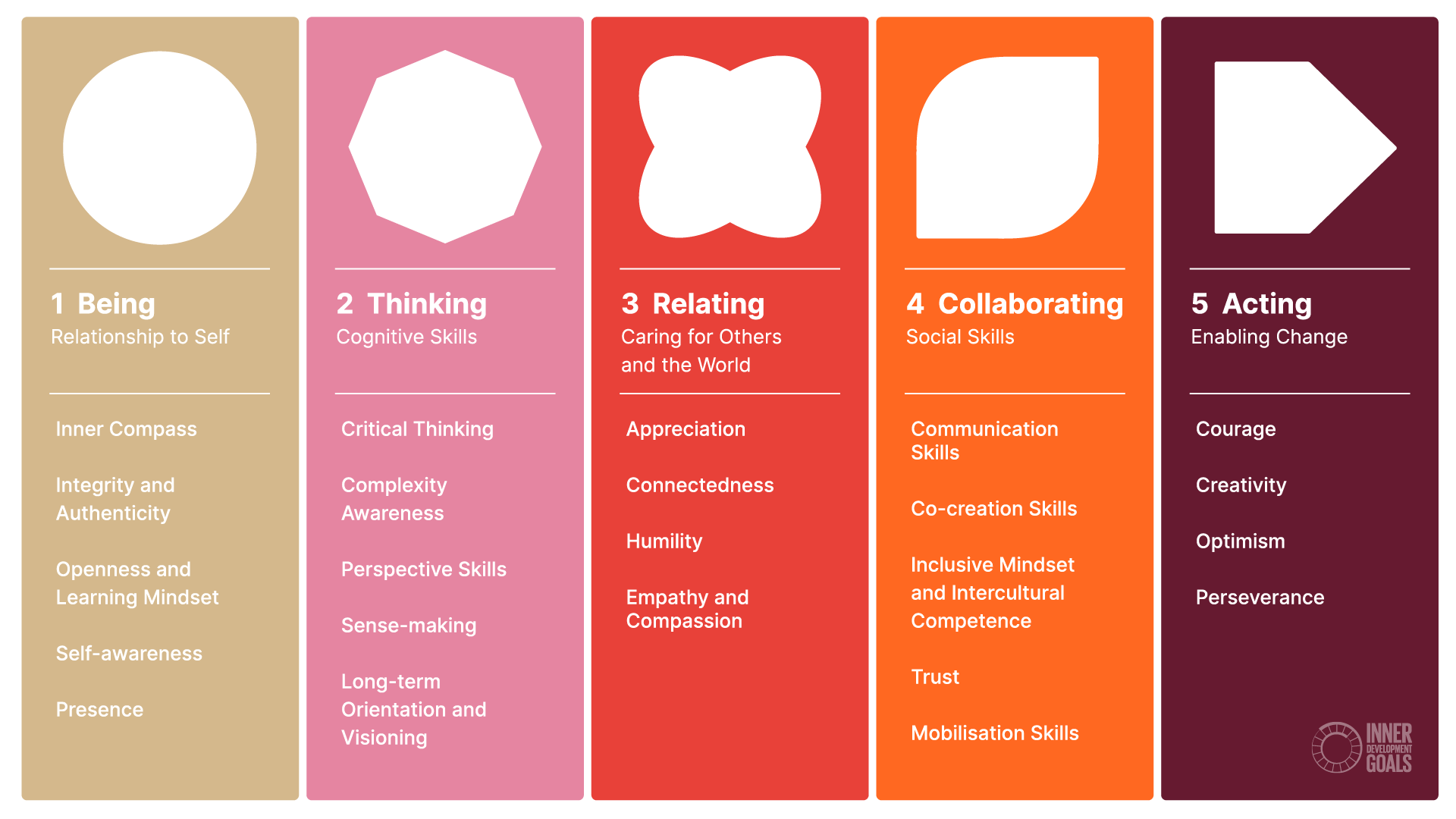
The Inner Development Goals guide and its 5 dimensions and 23 skills. The guide was updated from 23 to 25 skills while the Innosuisse project was underway; this report refers to the 23 skills in the original framework circa 2024–2025.
Findings by IDG dimension
Overall pattern: reflection is linked to growth across the board
Looking at change from the start to the end of the semester across all students who reflected with Rflect (AI and No AI groups combined), every one of the five IDG dimensions improved significantly:
| IDG | pre | post | p | N |
|---|---|---|---|---|
| Acting | 5.22 | 5.36 | < .05 | 130 |
| Being | 4.92 | 5.03 | < .01 | 140 |
| Collaborating | 5.20 | 5.32 | < .01 | 130 |
| Thinking | 5.40 | 5.55 | < .01 | 140 |
| Relating | 5.06 | 5.36 | < .001 | 51 |
Pre- and post-semester values are mean scores on the 1–7 self-assessment scale (1 = lowest, 7 = highest).
At the underlying skill level, 17 of 23 skills improved significantly over the semester (p < .05), including large, highly significant gains in Communication Skills, Self-Awareness, Critical Thinking, Perseverance, and Trust. Five skills did not show a significant change — Complexity Awareness, Co-Creation Skills, Inclusive Mindset and Intercultural Competence, Optimism, and Presence — and one, Openness and Learning Mindset, showed a small but statistically significant decrease (5.07 to 4.93, p < .05).
| Skill | pre | post | p | N |
|---|---|---|---|---|
| Communication Skills | 5.22 | 5.48 | < .001 | 455 |
| Complexity Awareness | 5.88 | 5.93 | .21 | 315 |
| Courage | 5.33 | 5.52 | < .01 | 197 |
| Creativity | 4.86 | 5.06 | < .001 | 252 |
| Critical Thinking | 5.37 | 5.54 | < .001 | 553 |
| Mobilisation Skills | 5.03 | 5.27 | < .001 | 180 |
| Appreciation | 6.12 | 6.24 | < .01 | 371 |
| Co-Creation Skills | 5.74 | 5.79 | .34 | 199 |
| Connectedness | 4.83 | 5.02 | < .01 | 149 |
| Humility | 4.53 | 4.75 | < .01 | 141 |
| Inclusive Mindset and Intercultural Competence | 5.55 | 5.59 | .51 | 174 |
| Inner Compass | 5.13 | 5.35 | < .001 | 220 |
| Integrity and Authenticity | 4.76 | 4.85 | < .05 | 258 |
| Longterm Orientation and Visioning | 5.49 | 5.64 | < .01 | 175 |
| Openness and Learning Mindset | 5.07 | 4.93 | < .05 | 222 |
| Optimism | 5.60 | 5.57 | .71 | 131 |
| Perseverance | 5.18 | 5.44 | < .001 | 443 |
| Perspective Skills | 5.05 | 5.28 | < .01 | 202 |
| Presence | 4.59 | 4.67 | .39 | 149 |
| Self-Awareness | 5.24 | 5.40 | < .001 | 566 |
| Sense-Making | 5.31 | 5.54 | < .01 | 144 |
| Trust | 4.68 | 4.78 | < .05 | 495 |
| Empathy and Compassion | 4.87 | 5.30 | < .001 | 62 |
Pre- and post-semester values are mean scores on the 1–7 self-assessment scale (1 = lowest, 7 = highest).
Key takeaway: Across a semester of regular reflection in Rflect, students moved on every IDG dimension and on the large majority of the underlying skills.
Did AI feedback make an additional difference?
To isolate the effect of AI feedback specifically, the researchers modelled each IDG dimension and skill as a function of condition (AI vs. No AI) and time spent reflecting (in seconds), including their interaction. Time spent reflecting correlated strongly with how much students wrote (r = .67 with reflection length in characters), giving a reasonable proxy for depth of engagement.
At the level of the five overall IDG dimensions, none of the condition effects reached statistical significance — meaning that, controlling for time spent, being in the AI group versus the No AI group did not predict a significantly different change in Acting, Being, Collaborating, Thinking, or Relating. In other words, both approaches were associated with meaningful growth, and this analysis did not find evidence that AI feedback outperformed reflection alone at the dimension level (nor the reverse).
At the more granular construct level — the psychological constructs used to measure the IDGs and their skills in the Rflect assessment, such as Honesty-Humility or Growth Mindset — a small number of specific effects did reach significance out of roughly 60 models tested:
- Courage (within Acting): among students in the No AI group, more time spent reflecting was associated with a significantly stronger relationship with Courage than in the AI group (interaction estimate = 0.406, p = .038).
- Respect (a construct within Inclusive Mindset, part of Collaborating): the same pattern appeared — time spent reflecting related more strongly to Respect in the No AI group than the AI group (interaction estimate = 0.692, p = .008).
- Honesty-Humility (within Integrity and Authenticity, part of Being): students in the No AI group scored significantly higher than the AI group on this construct (estimate = 0.485, p = .022).
- Fairness (also within Integrity and Authenticity): students in the No AI group scored significantly higher than the AI group here as well (estimate = 0.553, p = .021).
- Co-Creation Skills (within Collaborating): time spent reflecting was associated with significantly higher Co-Creation Skills scores, regardless of AI condition (estimate = 0.178, p = .025).
We report these transparently rather than selectively: on the small set of constructs where a significant difference did emerge, it tended to favour the No AI group or was independent of AI conditions altogether. We don’t yet have an explanation for why AI feedback would relate differently to constructs like Honesty-Humility or Fairness specifically — this is a genuine open question rather than a conclusion, especially given how many individual models were tested (a pattern of a few significant results among ~60 comparisons is also within the range expected by chance alone).
Open questions and limitations
- No control-group comparison: because the control group did not complete a post-semester assessment, it is difficult to infer anything with complete certainty — i.e. this analysis cannot speak to whether reflecting with Rflect (in either condition) outperforms not reflecting at all.
- Uneven course and institution distribution: the final Full AI sample came from 2 institutions and 4 courses, while the No AI sample came from 3 institutions and 5 courses — a reminder that results may be shaped by course-specific factors as much as by the tool itself.
- Lecturer and onboarding variability: the research team noted that student motivation to engage with the study was closely tied to individual lecturers’ own engagement, and that ensuring consistent onboarding messaging across many lecturers and courses was genuinely difficult.
- UI and prompt design matter: the team noted that the way the interface is set up, and the specific type of reflection prompts used, have an effect on how (and whether) students engage with AI feedback — variables this study could not fully isolate.
Concluding remarks
The clearest finding from this analysis is also the most encouraging one for anyone building reflection into a course: students who used Rflect over a semester — whether or not they used AI feedback — showed measurable growth across all five Inner Development Goals dimensions and the majority of underlying skills. Reflection with Rflect could be one of the main mechanisms explaining the positive development, but future studies are needed to test if this is truly the case.
What this analysis does not yet show is a clear, dimension-level advantage for AI-supported reflection over reflection alone — and in a few specific constructs, the No AI group came out ahead. To what extent, or whether, AI feedback plays a more specific, still-unproven role is something that we’ll continue to investigate — including through the reflection-depth findings in our companion report, where AI feedback was linked to longer, more substantive reflections. Understanding how those two threads (reflection depth and IDG development) connect could be a natural next step for future research.
We’re grateful to Innosuisse, Anna Jasinenko and Michael Ohlinger for their contribution to the project, and to the participating institutions, lecturers, and students who made this study possible.
Key takeaway: Reflection itself is doing visible work on students’ inner development. Whether AI feedback adds to that — and where — is still an open question, and one we intend to keep asking in public.
About Rflect
Rflect provides universities with the infrastructure to authentically teach and assess the human skills AI cannot replace. Learn more at rflect.ch. Have questions? Get in touch: info@rflect.ch.