
Repurposing Reflection in Education: from an assessment method to a learnable practice
This blog is written by Dr. Pascal Frank. Assistant Professor for ‘Inner Development and Sustainability’ at Wageningen University & Research and Academic Advisor to Rflect.
Reflection is widely considered a key skill in learning and education.
Students are asked to reflect on their values, their learning processes, their skill development, their experiences with learning contents etc.
But what do learners actually do when they are asked to reflect?
And what is the reflection really for?
Reflection as something to “show what you can!”
Looking at how reflection is often used in education, it very much reminds me of gymnastics during my school sports lessons. The way you were supposed to learn handstands was by doing handstands. Either you can do it—or you can’t. If you succeed, you get a good grade, if you fail, you don’t.
What’s missing is obvious: no one teaches you how to do a handstand. There is no specific feedback that allows you to systematically identify your weaknesses, deliberately choose the right progressions, and step by step develop the skill to do a handstand. In other words: The handstand is actually treated as a performance test, not a skill to be learned.
Reflection is often approached in exactly the same way. Perhaps even worse: We might not even know what exactly we want students to do when asking them to reflect. For example: Let’s assume that Ben is enrolled in a presentation skills training course. In the beginning of the course, Ben is asked to formulate a learning goal (note that we could consider this formulation already a reflection). Ben decides to focus on building more confidence when presenting, and after a couple of weeks, he needs to write an interim reflection on the learning progress. What exactly is Ben supposed to do?
Most probably, lecturers have implicit ideas and expectations in terms of what should come out of the interim reflection, e.g. that Ben:
- critically examines his own learning approach
- identifies concrete moments that indicate progress or difficulty
- provides evidence for learning (or lack thereof)
- comes up with specific steps to move on
- and articulate all of this in a coherent, reflective language
But not only are these expectations often not made explicit, they are also not taught, or practiced in their own right. In other words: Ben does not learn to reflect, but simply demonstrates his current ability to do so (and without actually knowing what he is doing).
Ben’s situation is not an exception. It reflects a broader tendency in education: many practices are designed less to develop skills than to test and certify them. Therefore, scholars like Bryan Caplan (2018) claim that education often ends up signalling pre-existing abilities rather than deliberately building new ones. Reflection tasks can easily fall into this pattern.
For this reason, many students do not experience reflection as genuinely useful. Given that reflection tasks are often somewhat arbitrary and vague, they can become a somewhat annoying must-do rather than a meaningful learning activity.
Lecturers, in turn, hesitate to provide substantive feedback. Without shared criteria or an explicit model of reflection as a skill, feedback often stays superficial—or is avoided altogether.
Making reflection learnable
But how can we introduce reflection as a skill, something that can be learned and improved through practice?
Let’s come back to the handstand analogy. A handstand is not learned by repeatedly attempting the final performance. Successful learning follows a small number of principles that structure practice and make improvement possible.
Clear directedness
Learning a handstand starts with a clear goal: balancing the body upside down by stacking wrists, shoulders, hips, and feet. This goal gives direction to practice, which is associated with better learning and performance than vague “do your best” intentions (Locke & Latham, 2002; Zimmerman, 2008). Specific drills and activities are not done “in general,” but in service of this specific outcome.
Progressive complexity and task decomposition
In order to facilitate learning, we need to progressively increase complexity (Reiser & Tabak, 2014; Christiansen et al., 2020). No one begins with a free-standing handstand. Learners move through isolated tasks and progressions:
- building shoulder strength in plank positions and gradually increase the load
- practicing inverted balance with wall support and gradually reduce external support
- steadily increasing the time under tension
- etc.
Each progression is chosen based on the current level of the learner and hence introduces a manageable challenge. Difficulty increases only when the current level is sufficiently stable.
Repetition and spaced learning
Learning progress depends on repeated practice over time (Brown et al., 2014; Kang, 2016). Balance, strength, tissue adaptation, and coordination are not acquired by doing it once, but through regularly recurring exposure and adjustment. One successful attempt does not replace many imperfect ones.
Feedback-driven deliberate practice
Every handstand attempt produces feedback. Falling is feedback. Losing balance is feedback. Fatigue in the shoulders is feedback. This information tells the learner what is not yet working.
Deliberate practice emerges from this feedback (Ericsson, 2006). Instead of repeating the same failed attempt, the learner identifies weaknesses and adjusts: focusing on shoulder engagement, preparing wrists, or returning to wall-supported practice. Practice becomes targeted rather than generic.
When these elements come together, the learner is not simply doing handstands, but systematically develops a skill.
Reflection can work in exactly the same way. Without clear goals, structured progressions, repetition, and feedback-driven deliberate practice, asking students to “reflect” is equivalent to asking them to perform a handstand without systematic guidance on how to do it. It becomes an assessment task, not a learning opportunity.
Reflection as introspective practice
As we have seen, reflection can (implicitly) mean different things. In order to make it learnable, we want to explicitly specify it first. One way to specify it is to consider it being an introspective practice: the deliberate act of attending to one’s lived experience. Such a definition allows us to more clearly point out what kind of ability we want to cultivate, when students are not reflecting in the above-mentioned sense, and what kind of steps students need to take in order to learn how to reflect.
To make this more tangible, let us come back to Ben.
Suppose Ben writes the following reflection:
“My presentation went reasonably well, although I was still a bit insecure. I think I need to prepare even better next time and work on my confidence when speaking in front of others.”
At first glance, this sounds reflective. But according to the understanding developed here, it mostly consists of general evaluations and explanations. It does not actually attend to Ben’s lived experience during the presentation.
If reflection is understood as attending to lived experience, Ben first needs to learn what attending to experience actually means - and what it doesn’t.
The first step is learning how lived experience unfolds in specific moments in time. Lived experience is always momentary: it happens now, not in general. Without learning to attend to concrete moments, there is no experience to reflect on—only summaries and abstractions. Reflection as introspection therefore requires Ben to learn to focus on particular instants rather than general descriptions. Instead of reflecting on “the presentation,” he might attend to the moment he began speaking, the second he noticed the audience, or the instant he hesitated. These moments provide the temporal anchor that makes experience accessible at all.
The second step is learning to distinguish lived experience from knowledge, explanations, justifications, and judgements. Much of what appears in reflection already consists of interpretations: “They were judging me,” “I was unprepared,” “The feedback was unfair.” Learning to reflect does not mean suppressing such content, but learning to recognize it as content of experience, rather than taking it at face value. For Ben, this might involve noticing the thought “They are judging me” as something that appeared, alongside sensations of tension and an urge to rush—without immediately treating the thought as a true description of the situation. The tendency to explain is itself part of lived experience, but the explanation does not become valid simply by appearing.
The third step consists in continuously deepening one’s engagement with actual lived experience and learning to describe it more accurately. Early reflections often remain superficial, naming broad emotional categories or outcomes. With practice, Ben can learn to notice finer distinctions: subtle shifts in attention, changes in bodily and sensory experience, fleeting impulses to act or withdraw.
A reflection grounded in these principles might therefore sound more like this:
“When I started speaking, I noticed my voice becoming faster and my shoulders tightening. When someone in the front row looked at me, the thought ‘They are judging me’ appeared and I felt an urge to rush through the slide. For a moment I lost track of what I wanted to say next.”
This kind of description does not prematurely explain or evaluate the situation, but it stays close to what was actually lived.
Of course, developing the ability to reflect in such a way does not emerge by reflecting once. It requires repetition and deliberate practice based on feedback (Ericsson, 2006). Feedback might point out when Ben is interpreting too early, when descriptions remain vague, or when time frames are too broad - and point to specific improvements. Each reflection attempt then becomes an opportunity to adjust focus, refine descriptions, and practice attending more precisely. Over time, what initially feels artificial or effortful becomes more natural.
The role of educators — and of Rflect
Rflect considers reflection as a vehicle to support learning across contexts. Central to this approach is reflection understood as an introspective practice. Lived experience accompanies all actions and learning processes—whether students develop presentation skills, engage in complex problem-solving and collaboration, or attempt to build resilience in the face of the current polycrisis. Learning to systematically attend to and engage with experience is therefore of great importance regardless of the specific study program or learning goals pursued. Thus, reflection as introspective practice constitutes an essential component of such engagement.
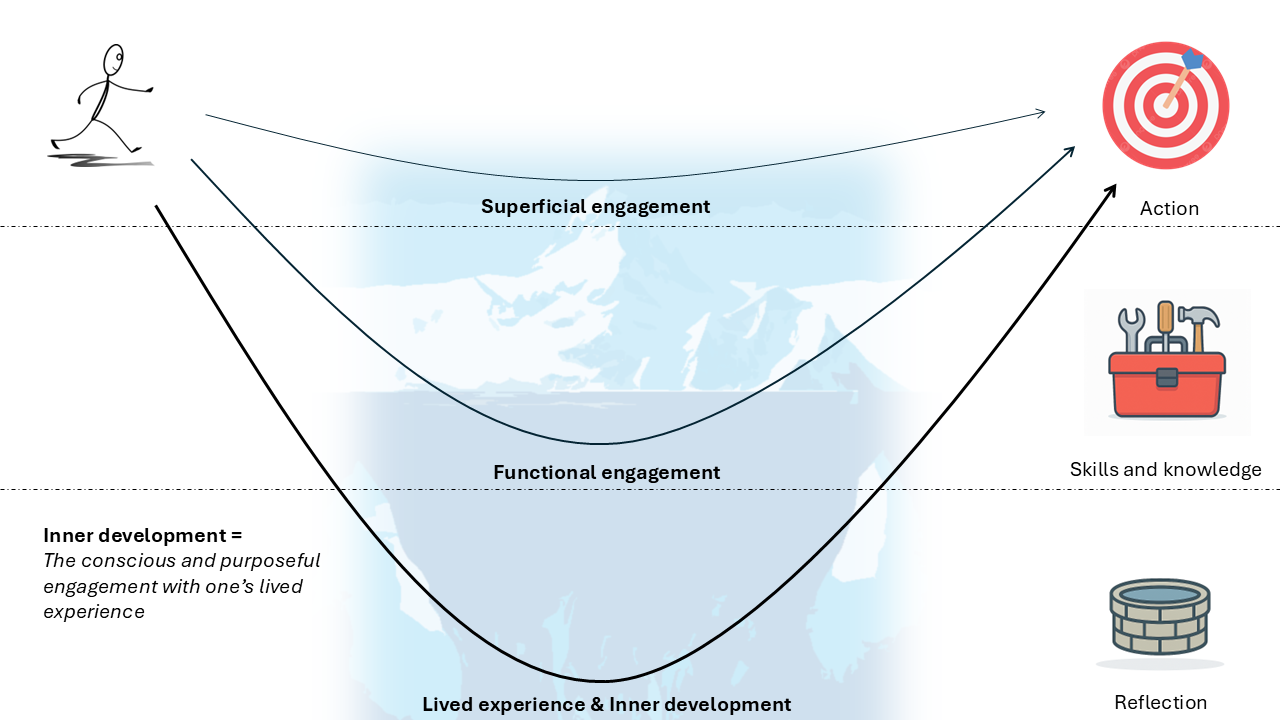
For this purpose, however, reflection needs to be systematically taught, not merely requested. This shifts the role of educators from evaluating reflective outputs to enabling reflective practice. Instead of primarily judging what students conclude, educators can support how students learn to reflect: by clarifying what reflection is directed at, by breaking it down into manageable steps, and by accompanying students as their reflective abilities develop over time.
Rflect is designed to support this shift. It offers features that can help make expectations explicit, facilitate feedback that targets the reflective process rather than its outcomes, and thereby invite repeated and deliberate engagement with reflection. Approached in this way, reflection no longer functions primarily as a signal of competence, but carries the potential to become what it was often meant to be: a learnable ability that develops through practice, feedback, and gradual refinement across learning contexts.
Sources:
- Brown, P. C., Roediger, H. L., & McDaniel, M. A. (2014). Make it stick: The science of successful learning. Harvard University Press. Caplan, B. (2018). The case against education: Why the education system is a waste of time and money. Princeton University Press.
- Christiansen, L., Larsen, M. N., Madsen, M. J., Grey, M. J., & Nielsen, J. B. (2020). Long-term motor skill training with individually adjusted progressive difficulty enhances learning and promotes corticospinal plasticity. Scientific Reports, 10, 15513.
- Ericsson, K. A. (2006). The influence of experience and deliberate practice on the development of superior expert performance. In K. A. Ericsson, N. Charness, P. J. Feltovich, & R. R. Hoffman (Eds.), The Cambridge handbook of expertise and expert performance (pp. 683–703). Cambridge University Press.https://doi.org/10.1017/CBO9780511816796.038
- Kang, S. H. K. (2016). Spaced repetition promotes efficient and effective learning: Policy implications for instruction. Policy Insights from the Behavioral and Brain Sciences, 3(1), 12–19.
- Locke, E. A., & Latham, G. P. (2002). Building a practically useful theory of goal setting and task motivation: A 35‑year odyssey. American Psychologist, 57(9), 705–717.
- Reiser, B. J., & Tabak, I. (2014). Scaffolding. In R. K. Sawyer (Ed.), The Cambridge handbook of the learning sciences (pp. 44–62). Cambridge University Press.
- Zimmerman, B. J. (2008). Investigating self‑regulation and motivation: Historical background, methodological developments, and future prospects. American Educational Research Journal, 45(1), 166–183.